
Table of Contents
- Assess Your Retirement Needs and Timeline
- Calculate How Long $500,000 Will Last in Retirement
- Apply the 4% Withdrawal Rule and Sustainable Withdrawals
- Build a Retirement Budget Example With $500K
- Use a Retirement Withdrawal Calculator to Model Scenarios
- Protect Retirement Savings From Inflation and Market Risk
- Combine Social Security, Annuities, and Part-Time Income
- Frequently Asked Questions
Last Updated: October 17, 2026
Assess Your Retirement Needs and Timeline
Retirement planning for 500k savings starts with one question: How much do you need to spend each year? Without that answer, you’re flying blind.
Most people underestimate retirement expenses, assuming they’ll spend less without a commute or work clothes. In reality, travel, healthcare, and hobbies often cost more than expected.
Start here:
- List your current annual spending
- Identify what will change (no mortgage, no commute, more travel)
- Add 10-15% for unexpected costs
- Factor in healthcare before Medicare kicks in at 65
Your retirement age matters too. Retiring at 55 versus 67 changes everything: a longer retirement means your $500,000 must stretch further, and the timeline affects how much market risk you can take.
Many people focus on the number ($500K) and forget the timeline. A 55-year-old and a 67-year-old face completely different challenges with the same savings. Start with your age and your target retirement date, that shapes every decision that follows.
Calculate How Long $500,000 Will Last in Retirement
How long $500,000 will last depends on four variables: annual spending, investment return, inflation, and lifespan. Single rule-of-thumb answers usually hide the assumptions that make them wrong for your situation.
A $500,000 portfolio withdrawn at a fixed dollar amount with no growth lasts 500,000 divided by your annual withdrawal: 20 years at $25,000, about 16.7 years at $30,000, and 12.5 years at $40,000. That is the floor.
A common shortcut is subtracting inflation from expected return to get a “real” return. If your portfolio earns 6% and inflation runs 3%, your real return is roughly 3%.
Here is a comparison table showing estimated years of portfolio longevity under different spending levels and real return assumptions. All figures assume a $500,000 starting balance, withdrawals at the start of each year, and no other income.
| Annual withdrawal | 0% real return | 2% real return | 3% real return | 4% real return |
|---|---|---|---|---|
| $20,000 | 25.0 years | 30.8 years | 35.0 years | 41.0 years |
| $25,000 | 20.0 years | 23.4 years | 26.6 years | 31.4 years |
| $30,000 | 16.7 years | 19.0 years | 21.5 years | 25.4 years |
| $35,000 | 14.3 years | 16.0 years | 17.9 years | 20.8 years |
| $40,000 | 12.5 years | 13.9 years | 15.4 years | 17.7 years |
| $45,000 | 11.1 years | 12.2 years | 13.4 years | 15.2 years |
Moving from $30,000 to $35,000 in spending cuts roughly three to four years off the portfolio at every return level.
Now add Social Security. If you claim $24,000 per year and spend $45,000, your portfolio only needs to cover $21,000.
These projections assume steady returns. Real markets do not deliver steady returns. A portfolio that averages 6% can still fail if the bad years arrive first. That is sequence-of-returns risk, and it is the single biggest reason a plan that looks fine on paper runs out of money in practice. The next section shows how to test for it.
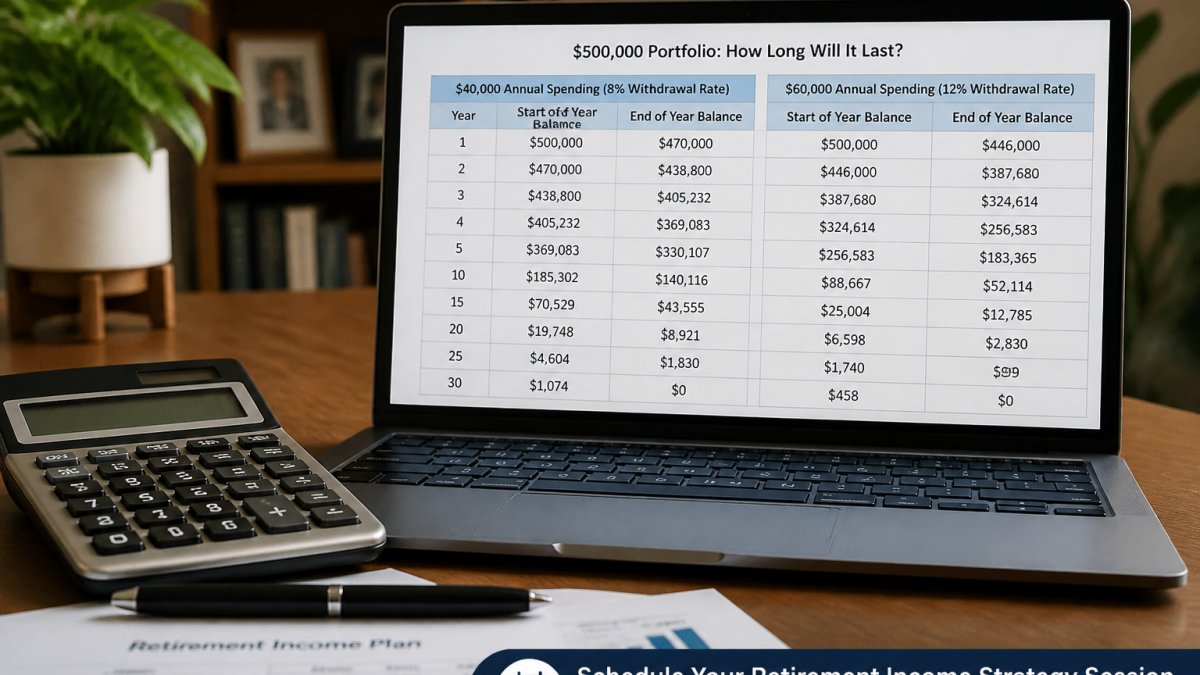
The honest answer to “how long will $500,000 last” is a range, not a number. At $25,000 per year of withdrawals and a 3% real return, plan for roughly 25 to 30 years. At $40,000 per year, plan for roughly 15 years. Social Security and part-time income stretch both outcomes. Build your plan around the range, not the midpoint.
Apply the 4% Withdrawal Rule and Sustainable Withdrawals
The 4% withdrawal rule is simple: take 4% of your portfolio in year one, then adjust for inflation each year after. On $500,000, that’s $20,000 in year one. The rule was designed for a 95% success rate over a 30-year retirement, not perfect, but a solid starting point.
Here’s how it works:
- Year 1: Withdraw $20,000 (4% of $500K)
- Year 2: Withdraw $20,600 (4% of $500K, adjusted for inflation)
- Year 3: Withdraw $21,218 (adjusted again)
- Continue for 30 years
The rule assumes a portfolio diversified across stocks and bonds, and that you stick to the plan even when markets crash. Many people don’t.
For retirement planning for $500K savings, the 4% rule is a floor, not a ceiling. If you need more than $20,000 per year, you can work part-time, delay Social Security, reduce expenses, or combine income sources to fill the gap.
Build a Retirement Budget Example With $500K
Let’s build a real budget using $500,000 as the starting point. We’ll assume you’re 62 and planning to retire at 65.
Income sources:
- Portfolio withdrawals: $20,000/year (4% rule)
- Social Security at 67: $24,000/year (average benefit)
- Part-time work (optional): $10,000/year
Total annual income: $44,000-54,000
Typical retirement expenses:
- Housing (mortgage-free): $12,000
- Healthcare: $6,000
- Food and utilities: $8,000
- Transportation: $4,000
- Travel and leisure: $8,000
- Miscellaneous: $4,000
Total: $42,000/year
In this scenario, you’re covered: $500,000 plus Social Security sustains your lifestyle with a small cushion. But it assumes your home is paid off, you stay healthy, and no major market downturn hits in year one. If any of those change, your plan breaks.
That’s why many retirees with $500K work with advisors who specialize in retirement planning for 500k savings, not to manage every dollar, but to build a plan that survives real life.
| Budget Item | Annual Cost | Notes |
|---|---|---|
| Housing | $12,000 | Assumes no mortgage |
| Healthcare | $6,000 | Before Medicare |
| Food & Utilities | $8,000 | Modest lifestyle |
| Transportation | $4,000 | One paid-off car |
| Travel & Leisure | $8,000 | 1-2 trips/year |
| Miscellaneous | $4,000 | Gifts, hobbies |
| Total | $42,000 | Annual spend |
Use a Retirement Withdrawal Calculator to Model Scenarios
A calculator is only as good as the scenarios you feed it. Most people run one scenario, average returns, spending, and lifespan, and call it a plan.
Here is a concrete way to stress-test a $500,000 portfolio.
Scenario 1, Base case. Portfolio covers $16,000 per year after Social Security begins. At a 3% real return, the portfolio lasts well beyond 30 years.
Schedule a Zoom or phone call →
Scenario 2, Early bear market. The portfolio drops 25% in year one, then recovers at historical averages. Because withdrawals continue, shares are sold at depressed prices.
Scenario 3, Higher spending. Spending rises to $55,000 per year instead of $40,000. The portfolio now covers $31,000 per year after Social Security.
Scenario 4, Longer life. You live to 95 instead of 85. Ten extra years of withdrawals at $16,000 to $31,000 per year is $160,000 to $310,000 of additional portfolio draw.
Scenario 5, Delayed Social Security. You wait until 70 to claim, raising your benefit from $24,000 to roughly $30,000 per year. The portfolio now covers $10,000 per year instead of $16,000.
| Scenario | Change from base | Approximate portfolio longevity |
|---|---|---|
| Base case | None | 35+ years |
| Early bear market | -25% in year one | ~25 years |
| Higher spending | $55,000/year | ~22 years |
| Longer life | Live to 95 | Plan must cover 30 years |
| Delayed Social Security | Claim at 70 | 40+ years |
These are illustrative projections, not predictions. Small changes in inputs produce large changes in outputs.
When you run scenarios, test these specific inputs:
- Real returns of 1%, 3%, and 5% (not nominal returns, which hide inflation)
- A market decline of 20% to 30% in years one through three
- Spending 10% and 20% above your base case
- Living to 90, 95, and 100
- Claiming Social Security at 62, 67, and 70
A plan that survives most combinations is robust; one that only works in the base case is fragile.
Run the early-bear-market scenario first. If your plan survives a 25% drop in year one, it will likely survive most other shocks. If it does not, that is the problem to solve before anything else, usually by holding more cash and short-term bonds, delaying Social Security, or building in flexibility to cut spending in down years.
A calculator gives you numbers. For a deeper dive into how different strategies perform, listen to The Income For Life Show, where we discuss real retirement scenarios and how to stress-test your plan.
Protect Retirement Savings From Inflation and Market Risk
Your $500,000 faces two enemies: inflation and market volatility. Inflation averaging 2-3% annually cuts purchasing power roughly in half over 25 years, what costs $40,000 today costs $80,000 then. Market risk is different: a 30% drop in year one forces hard choices about cutting spending, selling at a loss, or working longer.
Strategies to manage both:
- Keep 2-3 years of spending in cash and bonds (reduces panic selling)
- Diversify across stocks, bonds, and alternatives
- Consider guaranteed income products like annuities for essential expenses
- Delay Social Security to age 70 if possible (increases your lifetime benefit by 32%)
- Adjust spending in down market years instead of selling stocks
Some retirees use annuities to cover basic living expenses, converting part of their $500,000 into guaranteed monthly income. You give up flexibility but gain certainty, often worth the trade-off for housing, food, and healthcare. If you’d like to understand how annuities fit into a broader retirement strategy, our FREE Educational Video on the truth about annuities breaks down the pros, cons, and when they make sense.
The biggest mistake is ignoring sequence-of-returns risk. A bad market early in retirement is far more damaging than a bad market late. Protecting your first 5-7 years of spending is the single most important thing you can do with $500,000.
Combine Social Security, Annuities, and Part-Time Income
Your $500,000 doesn’t work alone. It works best as part of a larger income picture.
Social Security is your foundation. The average benefit is $24,000 annually. Delaying from 62 to 67 increases it by 50%; delaying to 70 increases it by 76%.
Annuities convert savings into guaranteed income. You give the insurance company a lump sum. They pay you a fixed amount monthly for life. For essential expenses, this removes market risk completely.
Part-time work extends your runway. Working 10-15 hours per week at $20/hour adds $10,000-15,000 annually, 5-7 extra years of portfolio longevity. Rental income, dividend stocks, or other passive sources add another layer.
The math works like this: if Social Security covers 50% of your needs and an annuity covers 25%, your $500,000 portfolio only needs to cover the remaining 25%. That’s a much easier problem to solve.
When you combine multiple income sources, your $500,000 stretches further. More importantly, you sleep better at night.
The best plans aren’t built alone. To get started, take our STAY Retired Survey, it takes just a few minutes and gives us insight into your specific situation so we can provide tailored guidance.
Click Here To Schedule A Call with our team to discuss your specific situation. We’ll show you exactly how to turn your $500,000 into a retirement income plan that lasts.
Frequently Asked Questions
How much monthly income can $500,000 provide in retirement?
Using the 4% withdrawal rule, $500,000 generates roughly $20,000 per year, or about $1,667 per month. This assumes a balanced, diversified portfolio and accounts for inflation over time. Your actual monthly income depends on your retirement age, life expectancy, investment returns, and whether you combine this with Social Security or other income sources. A retirement withdrawal calculator helps you model different scenarios based on your specific situation.
How long can $500,000 last in retirement?
If you withdraw 4% annually ($20,000 per year), adjusted for inflation, $500,000 can sustain retirement for 25 to 30+ years for many retirees. Longevity depends on your spending rate, investment returns, inflation, and healthcare costs. Someone retiring at 55 faces a longer retirement horizon than someone at 70. Using a retirement withdrawal calculator with your specific age, expenses, and risk tolerance gives you a clearer picture of whether your $500,000 nest egg will last.
What is the best way to protect $500,000 in retirement savings from inflation?
Inflation erodes purchasing power over time. Protect your retirement savings by maintaining a diversified portfolio with inflation-resistant assets such as stocks, Treasury Inflation-Protected Securities (TIPS), and real estate. Consider guaranteed income products like annuities that adjust for inflation. Delay Social Security if possible to receive larger inflation-adjusted payments later. Review your retirement budget annually and adjust spending as needed. A professional advisor can help you structure your portfolio and income sources to outpace inflation throughout your retirement.
Can I retire at 55 with $500,000 in my 401(k)?
Retiring at 55 with $500,000 is possible but requires careful planning. At 55, you face 30+ years of retirement spending, which stretches your savings further. Early retirement means no Social Security yet, higher healthcare costs before Medicare eligibility, and potentially longer exposure to market volatility. A retirement budget example with $500K at age 55 typically requires keeping annual spending under $15,000 to $18,000 to sustain your nest egg. Combining part-time work, delaying Social Security, and using guaranteed income strategies can bridge the gap and reduce the burden on your savings.